Under review Accepted at LM4Sci @ COLM 2026
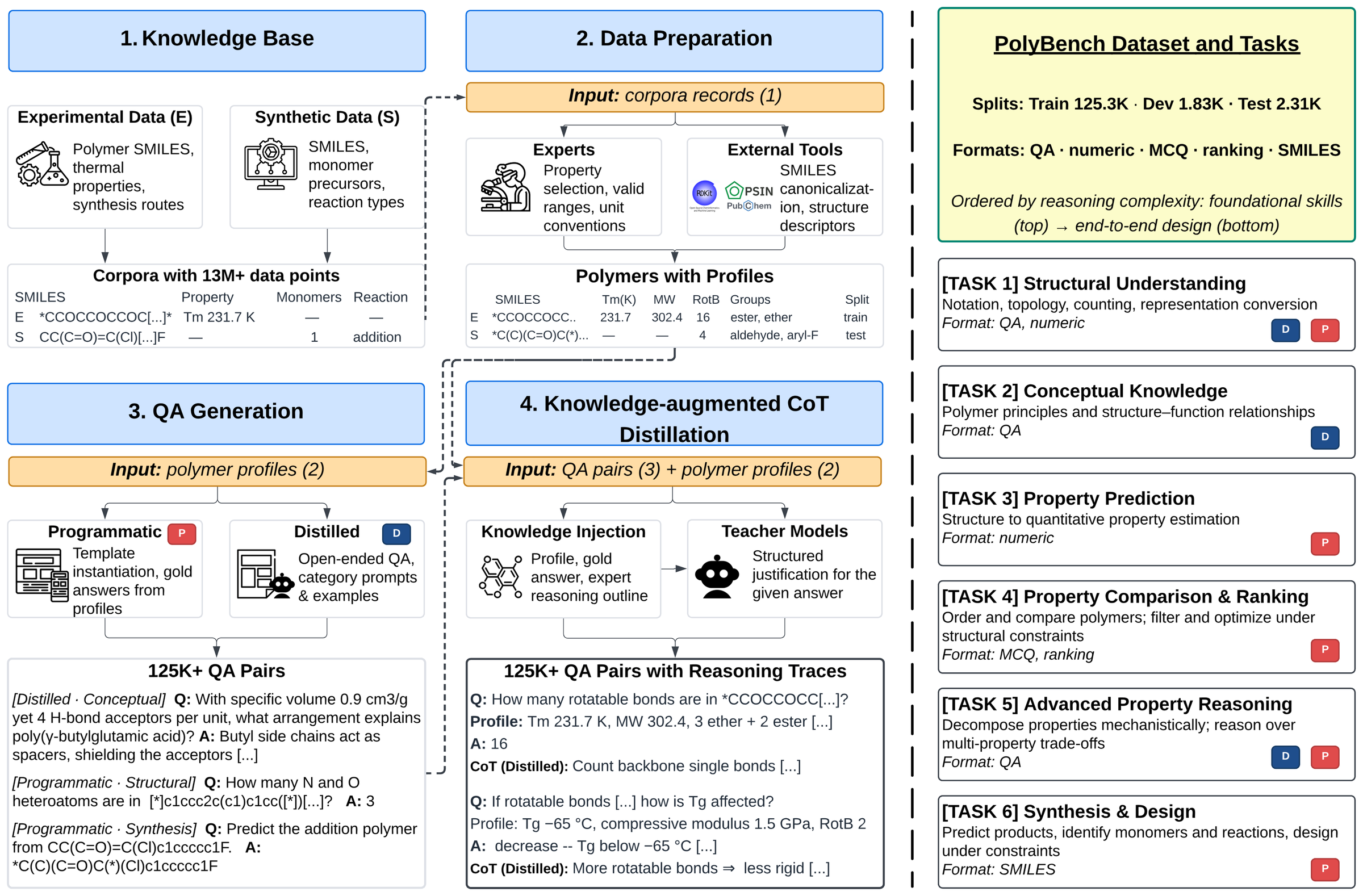
PolyBench is a large-scale training and evaluation benchmark of more than 125K polymer design-related tasks, grounded in a knowledge base of over 13 million experimental and synthetic polymer data points and augmented with knowledge-grounded chain-of-thought supervision.
Stony Brook University
Correspondence: dimohanty@cs.stonybrook.edu
The problem
A single design prompt jointly specifies property targets, available reactants, and functional constraints. A PolyBench-trained model has to decompose the prompt and emit a valid SMILES repeat unit that satisfies all of them at once.
Construction
Four stages, from raw polymer corpora to
(instruction, question, CoT, solution) tuples. Splits are applied to
polymers before task generation, so the test set contains unseen polymers,
properties, and task variations.
Aggregate open-source experimental and synthetic sources covering 13M+ polymers: SMILES, thermal and mechanical properties, monomer precursors, and reaction types.
Standardize notation, units, and structural descriptors with RDKit and subject-matter-expert input to build one polymer profile per entry.
Generate tasks programmatically from templates (78%) or by prompting a teacher model for open-ended formats (22%). Splits are applied before generation.
Condition teacher models on the full profile and gold answer so they explain provided evidence rather than recall it, then fact-check the resulting traces.
Results
We fine-tune Qwen-2.5-7B/14B/32B, Phi-4-14B, and ChemLLM-7B with LoRA for 3 epochs on the PolyBench train and dev sets, and compare against off-the-shelf, chemistry-aligned, and closed-source frontier models. Full per-task numbers across all six categories are in the paper; the headline findings are below.
Off-the-shelf base models struggle across the board, especially wherever SMILES is required. Chemistry-aligned models — Llamole-8B, LlaSMol-8B, ether0-24B, ChemLLM-7B — underperform on almost every PolyBench task: their knowledge is mostly about small molecules and does not carry over. Training the same ChemLLM-7B on PolyBench consistently beats its own base version, lifting chemical validity of generated structures from 0.25 to 0.95.
Across all six task categories, PolyBench-trained models outperform their off-the-shelf and domain-aligned counterparts, with the largest gains at 14B and 32B. Exact match on structural counting rises from 0.50 to 0.87 for Qwen-2.5-14B+CoT, and property-prediction error for Phi-4-14B drops from 46.2 to 16.8 MAE — the lowest of any model evaluated, frontier systems included.
Frontier models do well on foundational tasks but struggle to generate chemically valid SMILES that satisfy property, structure, and synthesis requirements at once. PolyBench-trained models reach higher structural similarity to the target polymer (0.82 vs. 0.48 for the strongest frontier baseline) while holding lower synthetic accessibility scores — placing their generations at the edge of the readily synthesizable range.
For 7B models, CoT training improves only 4–6 of 14 metrics; for the 14B–32B variants it improves 8–12. The clearest gains land on compositional tasks such as Advanced Property Reasoning, while tasks needing precise quantitative targets see limited or even negative gains — there the added reasoning mostly adds verbosity.
A subset of the design problems is open-ended: generate a molecule satisfying multiple competing constraints. Since several distinct molecules may satisfy the stated requirements, we score these reference-free — evaluating the generated molecule directly against the constraints stated in the question, using two independent verifiers.
Hard constraints, decidable from structure alone — no model judgment involved.
Soft constraints that cannot be resolved structurally, handled by a separate LLM verifier.
On the combined RDKit + LLM measure over the 200 open-ended design questions, our PolyBench-trained Phi-4-14B+CoT variant achieves the highest constraint satisfaction of any model evaluated — ahead of every frontier baseline.
Analysis
Standard metrics do not explain why models fail. Using diagnostic sub-questions generated alongside the main tasks, we run three experiments on PolyBench-trained Phi-4-14B+CoT to separate missing knowledge from failure to combine it.
Can the model answer atomic sub-questions in isolation? Mean precision is high across core skills — 89.4% for inference, 89.3% for definitions, 83.7% for comparison. The pieces are largely there.
Does the model's own CoT cover the required sub-questions? Precision stays high (93.0% on Conceptual Knowledge, 84.8% on Advanced Reasoning) but recall collapses — 47.4%, 44.1%, and just 7.0% on Comparison & Ranking.
Handed the sub-questions and their answers, scores rise across every category — but composing them into a consistently constraint-satisfying solution stays brittle.
| Task category | Exp 2 — CoT coverage | Exp 3 — mean score with added context | |||
|---|---|---|---|---|---|
| Precision | Recall | No context | + SubQs | + SubQs & answers | |
| Structural Understanding | 79.5% | 47.2% | 5.08 | 4.68 | 6.02 |
| Conceptual Knowledge | 93.0% | 47.4% | 4.98 | 6.26 | 6.48 |
| Property Prediction | 44.0% | 16.4% | 3.14 | 2.96 | 3.46 |
| Property Comparison & Ranking | 11.3% | 7.0% | 4.72 | 4.49 | 5.92 |
| Advanced Property Reasoning | 84.8% | 44.1% | 5.10 | 5.94 | 6.46 |
| Synthesis & Design | 36.3% | 16.6% | 4.30 | 4.84 | 5.28 |
Table 1. Diagnostic probes on Phi-4-14B+CoT. Models often know the necessary pieces (high precision) but fail to select and propagate the right constraints and steps in their own reasoning (low recall) — evidence of a compositionality gap rather than missing knowledge.
Availability
All associated data and code will be released under CC BY-NC 4.0 for non-commercial research use in the project GitHub repository. Fine-tuned model weights will be released on Hugging Face under their respective base model licenses (MIT for Phi-4, Apache 2.0 for Qwen-2.5).
CoT traces were generated via the official Claude-3.5-Sonnet and GPT-4o APIs for research in a specialized domain. We will release distilled CoT traces consistent with each provider's terms of service; where terms restrict redistribution, we will release only our post-processed, verified reasoning chains rather than raw teacher outputs.
Citation
@misc{mohanty2026polybench,
title = {Teaching and Evaluating {LLM}s to Reason About Polymer Design Related Tasks},
author = {Mohanty, Dikshya and Hasan, Mohammad Saqib and Monsur, Syed Mostofa
and Zheng, Size and Hsiao, Benjamin and Balasubramanian, Niranjan},
year = {2026},
note = {Under review. Accepted at the Workshop on Language Models for
Scientific Discovery (LM4Sci) at COLM 2026},
url = {https://github.com/StonyBrookNLP/PolyBench}
}